Elyra Weekly #1: Own Your Coding Agent
First post in a weekly series about Elyra — a terminal-first coding agent that treats the model as a replaceable part, not the product. Why your agent shouldn't have an opinion about whose models you use, plus four tips for keeping your setup lean and your token bill honest.
This is the first post in a weekly series about Elyra — why we build it the way we do, and the tips and tricks that make daily use a little nicer. New post every week.
There are a lot of coding agents out there now. Most of them are good. Several of them are made by the same companies that make the models, and that's exactly the thing this series will keep coming back to: your coding agent shouldn't have an opinion about whose models you use.
Why Elyra, in one paragraph
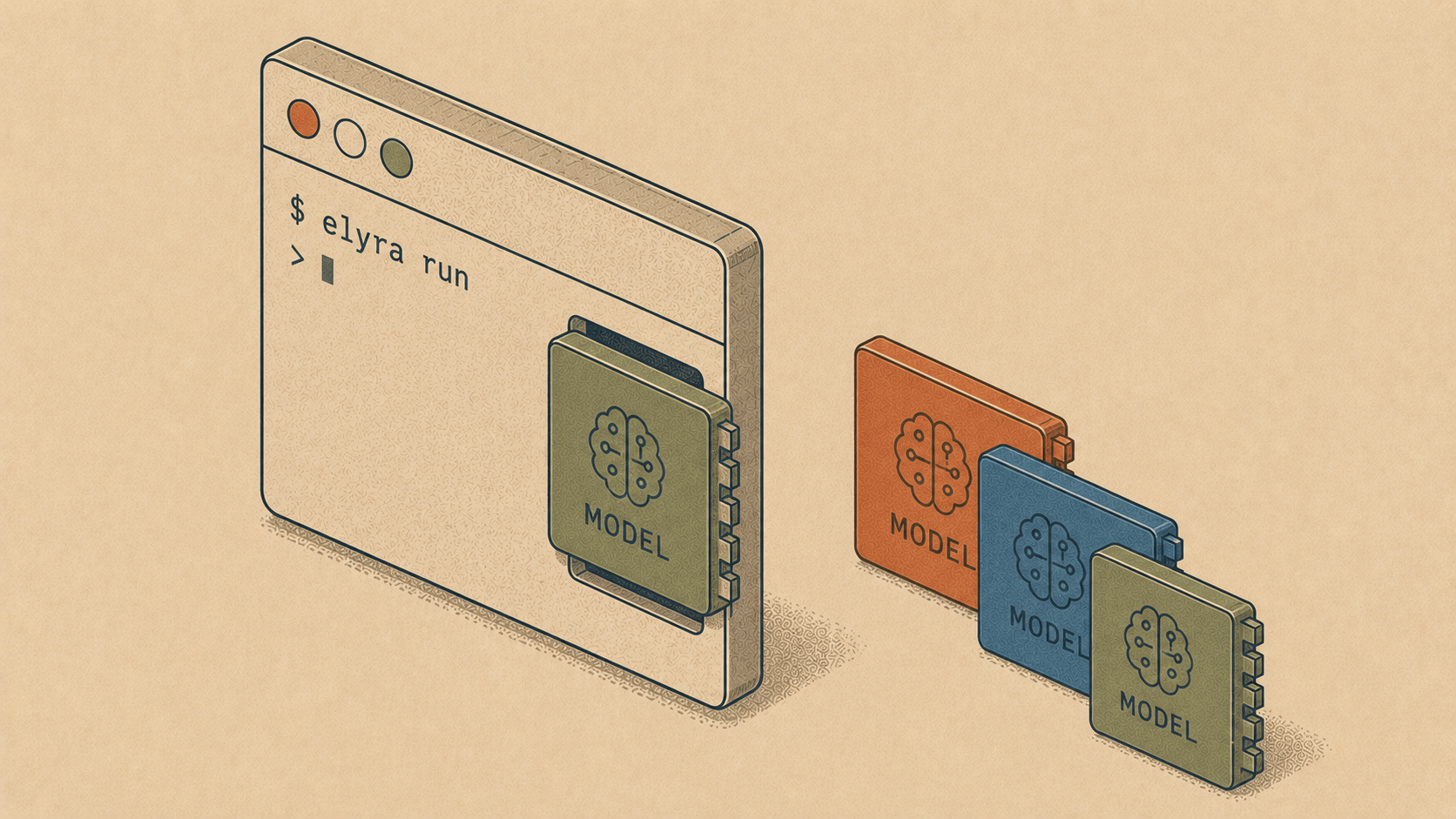
Elyra is a terminal-first coding agent that treats the model as a replaceable part, not the product. Log in with your Claude Pro/Max, ChatGPT, or Copilot subscription; paste an API key from Anthropic, OpenAI, Google, xAI, DeepSeek, or a dozen others; or run a coding plan from z.ai or Moonshot. Switch mid-session with /model. When Grok 4.6 or GLM 5.3 ships, it's in the registry within days — because keeping pace with the model landscape is our job, not your problem.
The case for not marrying your model vendor
Here's what the last two weeks alone looked like in the model world: Grok 4.6 appeared, GLM 5.3 landed with a 1M context window, Gemini 3.7 Flash arrived at $0.75/$3.75, GLM 5.2 dropped roughly 60% in price, and one model on a popular gateway quietly went from $0.95 to $3 per million input tokens.
If your agent is welded to one vendor, none of that is actionable. In Elyra it's a /model away — and if you'd rather not think about it at all, smart routing picks the right model per turn:
/route
Next turn: tier=standard (multi-file edit detected)
cheap    → gemini-3.7-flash
standard → glm-5.3
deep     → claude-opus-5
Elyra even keeps a local ledger of how models actually perform for you — success rates, edit failures, retries, real cost — visible with /routing-stats:
/routing-stats
Model                    Turns  Success  Edit fails  Avg cost/turn
glm-5.3                    142      97%          2      $0.004
claude-opus-5               38      99%          0      $0.061
gemini-3.7-flash            89      94%          5      $0.002
All measurements stay on your machine. No telemetry, no phoning home — just your own data working for you.
Only carry what you need
Elyra's core is deliberately small. Everything else — Laravel intelligence, LSP servers, browser automation, database tools, multi-agent pipelines — is an extension you opt into:
/ext
Extensions  (1 to install, 1 to remove)
→ [x]   browser-tools   Browser automation (Playwright)
[-] ✓ anna            Presentations: slides, demos
[ ] ✓ laravel         Deep Laravel understanding
✓ = installed · space marks [x] install / [-] remove
Space marks what you want changed — [x] install, [-] remove — and enter applies it all in one pass. A lean setup isn't just tidy: fewer tools means less context spent describing them to the model, which means cheaper and sharper turns.
Tips & tricks of the week
1. Audit your running instances. Elyra idles at zero CPU, but a session you forgot in a tmux pane three days ago still holds its memory:
$ elyra doctor resources
Running Elyra instances:
PID 48213   up 2h 14m   CPU 3m 12s   mem 310 MB
PID 17902   up 3d 6h    CPU 1m 44s   mem 288 MB   ⚠ looks forgotten
⚠ If you no longer need it:  kill 17902
2. Teach it once with /learn. Just walked the agent through your release procedure or a gnarly deploy? Run /learn and it distills the session into your AGENTS.md, so every future session already knows the drill:
/learn the release flow we just did
✓ Added "Release procedure" to AGENTS.md
3. Ask on the side with /btw. Need a quick answer mid-task without polluting your main session's context? The btw extension opens a parallel side conversation. Your main thread never sees it — and your context window stays focused on the actual work.
4. Sanity-check your setup. elyra doctor preflight validates every configured default against the registry — offline, in about a second — and tells you when a newer model in the same family is available:
$ elyra doctor preflight
✓ All default models resolve against the registry.
Newer models available for configured defaults:
- zai: glm-5.2 → glm-5.3
Get it
npm install -g @elyracode/coding-agent
elyra
Then /login for a subscription, or drop an API key, and /ext to pick your toolkit.
Next week: smart routing tiers in depth — how to pin the right model to the right job, and what goal economy mode does to your token bill.